
Article Directory
If a product weighs under 1 kg, sits on a retail shelf, and has to sell itself in three seconds, a folding carton is almost always the right format. If the same product enters a parcel network or ships in cases of six, corrugated board is the only structure that will hold the load. That decision is mechanical, not aesthetic, and it is settled long before the artwork is drawn.
Both formats begin as paper and are engineered in opposite directions. A folding carton is die-cut and scored from a single sheet of paperboard, normally 200 to 400 gsm solid bleached sulphate (SBS), coated recycled board (CRB), or GC1 folding boxboard, and it holds its shape through the stiffness of that sheet. A corrugated box bonds one or more linerboards to a fluted medium, forming a sandwich 1.5 mm to 7 mm thick whose load capacity is rated by edge crush test (ECT).
Use a folding carton when the product weighs under 1 kg and is displayed, hand-carried, or contained inside a secondary shipper. Use a corrugated box when the product exceeds 2 kg, when units are stacked more than three high, or when the box itself is the outer package moving through a courier network. Between 1 kg and 2 kg both formats can work, and the deciding factor becomes drop height and stack duration rather than weight alone.
| Attribute | Folding carton | Corrugated box |
| Base structure | Single sheet of paperboard | Linerboard bonded to a fluted medium |
| Board caliper | 0.3 mm to 0.6 mm | 1.5 mm to 7 mm |
| Typical grammage | 200 to 400 gsm (SBS, CRB, GC1) | 125 to 200 gsm liner with 90 to 150 gsm medium |
| Print method | Offset lithography, 175 to 200 lpi | Direct flexo at 65 to 100 lpi, or litho-lamination at 175 lpi |
| Structural rating | Bending stiffness and caliper | ECT 23 to 48 lb/in, converted to BCT by the McKee formula |
| Tooling | Cutting die plus 4 to 8 offset plates per SKU | Cutting die, flexo plates, slotting setup |
| Primary job | Shelf presence and product identity | Transit protection and stacking |
| Recycling stream | Paperboard, mixed with OCC | OCC, old corrugated containers |
Folding cartons lead on print resolution by roughly 50 index points and on shelf presentation by 42, while corrugated leads on stacking strength by 55 points and on drop protection by 60. The gap is measurable rather than stylistic: offset lithography resolves 175 to 200 lines per inch, while direct flexographic printing on corrugated typically resolves 65 to 100 lines per inch.
Relative capability index (0-100): folding carton against corrugated box
Index values are relative indicators built from typical production parameters: 175 to 200 lpi offset resolution against 65 to 100 lpi flexo, and 23 to 48 lb/in ECT ratings. They are not results from a single laboratory test.
Compression is the mirror image of print. A single-wall box rated at 32 lb/in ECT and formed in B-flute at roughly 3 mm caliper carries a stacking load that a 350 gsm paperboard carton cannot approach; the carton deforms under vertical load long before the corrugated panel deflects.
A folding carton printed offset at 175 to 200 lines per inch holds color across a 50,000-sheet run and ships flat, collapsing to roughly 5 to 10 percent of its assembled volume; that lowers warehouse space per SKU and reduces inbound freight on every reorder.
Substrate choice drives both appearance and cost. SBS gives the brightest print surface and is the standard for cosmetics and consumer electronics; CRB lowers cost for short-life items; GC1 folding boxboard pairs a coated white top with a grey back and is common in food and household packaging.
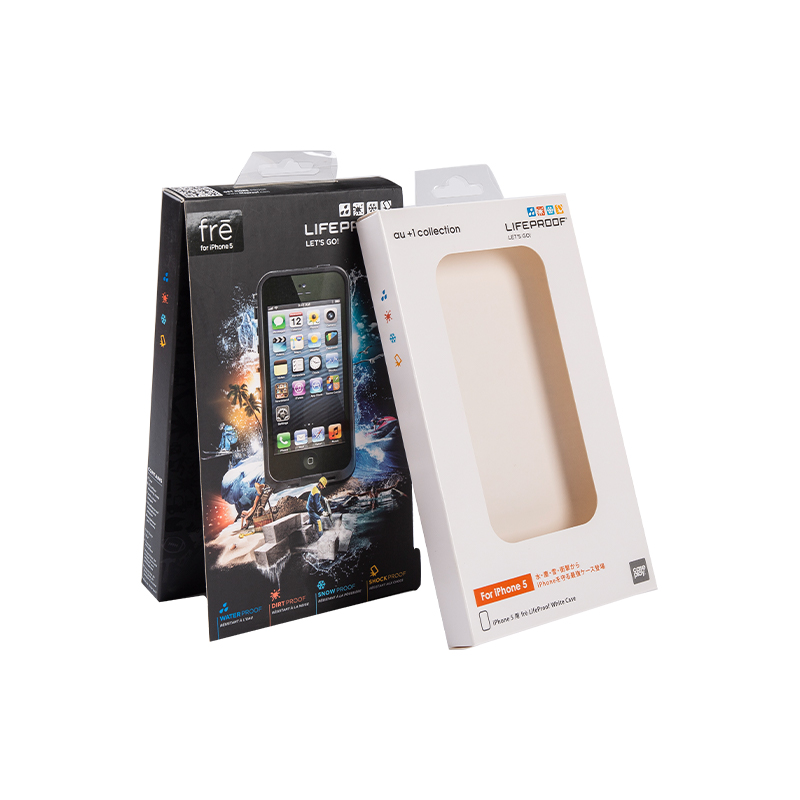
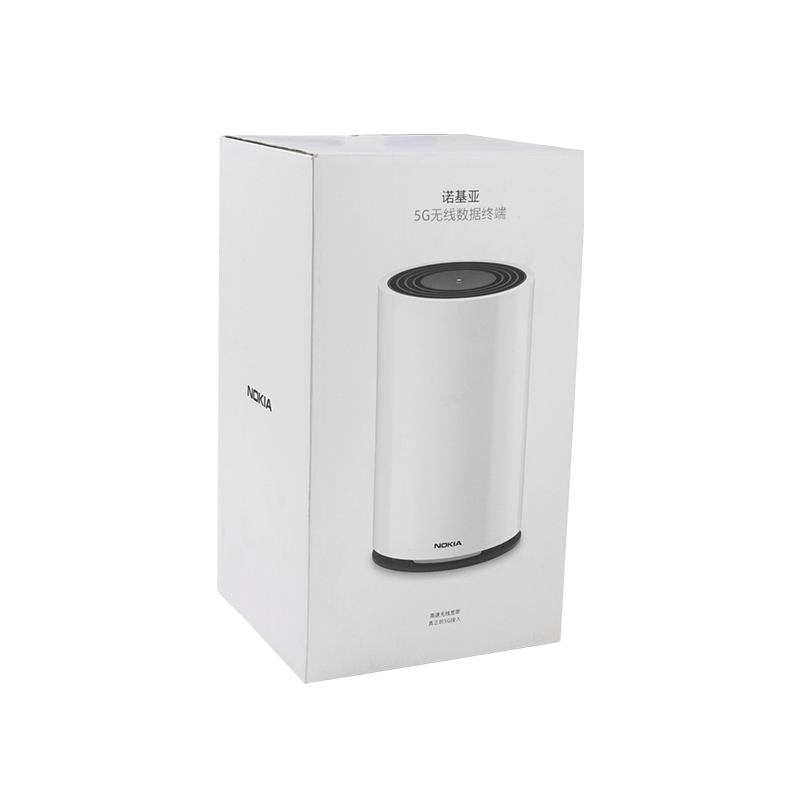 Electronic Products Packaging Design Carton Boxes Packaging BoxElectronic Products Packaging Design Carton Boxes Packaging Box provides high-quality, customized carton packaging for your products. Whether it is mobile phones, home...View Product →
When the product exceeds 2 kg, has a fragile protrusion, or must survive a 75 cm parcel drop without an outer box, paperboard alone will fail. The correct build is a paperboard carton inside a corrugated shipper, or a single printed corrugated mailer that removes the inner carton entirely.
A single-wall corrugated box in B-flute at 3 mm caliper with a 32 lb/in ECT rating is the standard workhorse for products up to about 15 kg. Its stacking limit is predicted by the McKee formula, BCT = 5.87 x ECT x the square root of caliper times box perimeter, which converts an edge crush rating into a box compression strength in pounds.
Flute profile is a deliberate trade. F-flute at 0.8 mm and E-flute at 1.5 mm print and fold like heavy paperboard and suit retail-ready mailers; B-flute at 3 mm and C-flute at 4 mm carry transit loads; BC double wall at 6 mm to 7 mm handles palletized industrial goods. Print quality follows the same line, because direct flexo delivers 65 to 100 lines per inch, while litho-lamination restores 175 lines per inch by printing the sheet first and mounting it to the board.
ECT is measured under TAPPI T811 after conditioning at 23 degrees Celsius and 50 percent relative humidity per ISO 2233, and distribution performance is validated against ISTA 3A or ASTM D4169 protocols. How corrugated strength is manufactured and printed is covered in more detail in the technical library.
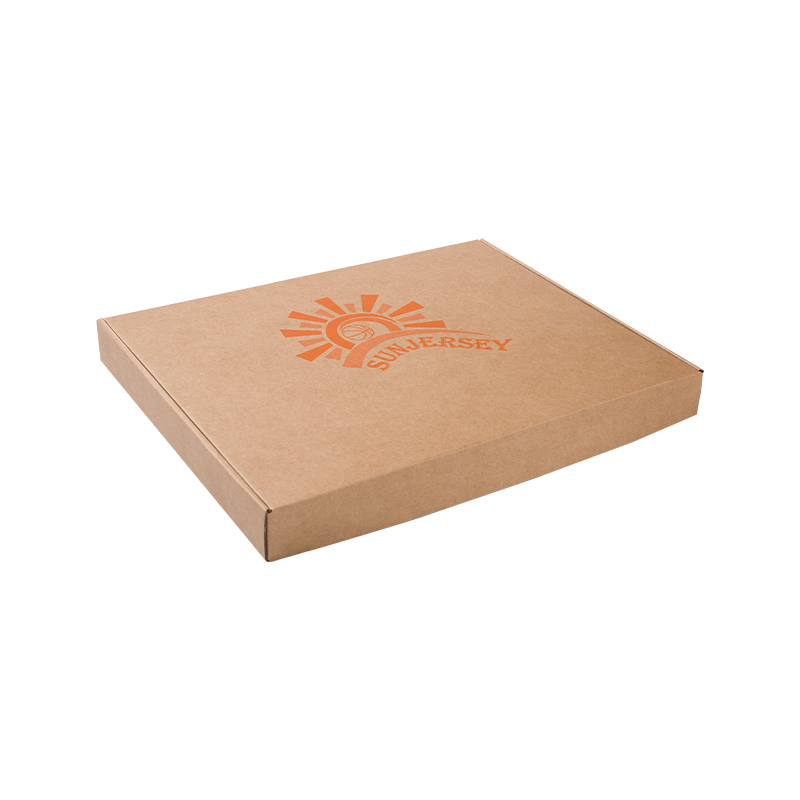
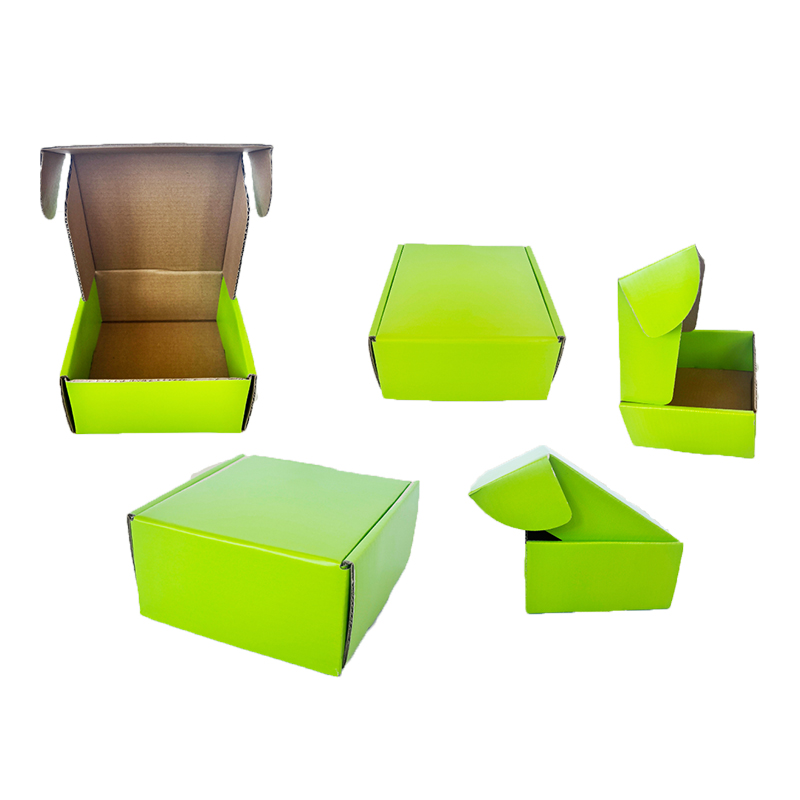 E-Commerce Mailer Printing Corrugated Airplane Box Aircraft Shipping Paper BoxE-Commerce Mailer Printing Corrugated Airplane Box Aircraft Shipping Paper Box is a corrugated box designed for e-commerce, with good compression resistance and protec...View Product →
Decide in this order: protection threshold, load path, then shelf and pallet module. Reversing the sequence produces packaging that is either overbuilt or crushed in transit.
Record product weight, longest dimension, drop height, stack height, and transit mode. A direct-to-consumer parcel typically needs a 75 cm drop test, while a palletized export load needs 48 hours of stacking at 40 degrees Celsius and 75 percent relative humidity.
Under 1 kg with shelf exposure, specify a folding carton at 300 to 400 gsm. Above 2 kg, or in any courier shipment where the box is the outer package, specify corrugated at 32 lb/in ECT minimum and 44 lb/in for fragile contents.
Align outer dimensions with the 600 x 400 mm pallet module and the 1200 x 1000 mm pallet footprint, then check retail shelf depth, which is usually 300 mm to 400 mm. A 5 mm dimensional change can move a case from 40 units per pallet to 36.
| Condition | Recommended format | Reason |
| Under 1 kg, sold from a shelf | Folding carton, 300 to 400 gsm | Offset print detail and flat storage |
| Over 2 kg, or six units packed together | Single-wall corrugated, 32 lb/in ECT | Stacking and handling loads |
| Direct-to-consumer parcel | E-flute or B-flute mailer | 75 cm drop protection without an outer box |
| Gift set with an inner tray | Corrugated outer plus paperboard inner | Print quality inside, protection outside |
| Full-bleed artwork on every panel | Litho-laminated corrugated | 175 lines per inch on a corrugated panel |
Suzhou New Century Color Printing Co., Ltd., founded in 2000 in the Suzhou National High-Tech District, converts both formats in a facility of more than 26,000 square meters, so a single project can move from a printed folding carton to a corrugated transport case without changing suppliers.
The practical takeaway is to choose from the load path outward, not from the shelf inward. Weight, drop height, and stack duration select the format; print method, finish, and structural features refine it. Buyers who start from the specification work with the physics of the shipment instead of against it.
Only for light, non-fragile items under 1 kg. A 350 gsm folding carton runs about 0.4 mm thick, roughly one-seventh the caliper of a B-flute panel, so direct-to-consumer programs standardize on an E-flute mailer at 1.5 mm with a 32 lb/in ECT rating.
A 10 kg product stacked three high places 20 kg, about 196 newtons, on the bottom box. With a safety factor of five for humidity and time, the target is roughly 980 newtons, or 220 pounds of box compression strength; for a 400 x 300 mm footprint in B-flute at 0.118 inch caliper, McKee's formula resolves that to about 15 lb/in ECT, which is why suppliers standardize on 32 lb/in rather than the theoretical minimum.
Not with direct flexo, which prints at 65 to 100 lines per inch. Litho-lamination closes the gap: the sheet is offset printed at 175 to 200 lines per inch first, then mounted to the corrugated board, giving a surface that matches a folding carton at a higher unit cost.
Printed PP retail product packaging boxes are a high-quality... View More
Electronic Products Packaging Design Carton Boxes Packaging ... View More
Customizable Shapes Corrugated Paper Display Boxes & Car... View More
Offset Printing Designs Cartons Packaging Boxes Folding Cart... View More
No. 88, Zhiying Street, High-tech Zone, Suzhou City, Jiangsu Province, China.
+(86)-512-6575-0991
+(86)-13776090470

Copyright © SuZhou New Century Color Printing Co., Ltd. Custom Printed Colored Corrugated Boxes





 Français
 Español
 عربى