
Article Directory
A folding carton that scores cleanly in a pressroom running at 50% relative humidity can crack along the same crease in a distribution centre sitting at 25% relative humidity. The board has not changed; the water inside it has. Paperboard settles at roughly 6% to 8% moisture content under ISO 187 conditioning at 23 degrees Celsius and 50% RH, and every point of humidity the sheet loses stiffens it and raises crease-cracking risk. Choosing paperboard for custom printed packaging is therefore a climate decision as much as a visual one, and it is the first decision worth locking down.
The sequence that prevents expensive reprints is fixed: board grade and grammage first, print method second, surface finish third, window and barrier requirements last. Reverse that order, for example by approving a soft-touch matte lamination before confirming the board survives a 3 mm fold radius, and the second print run costs more than the first.
Paperboard grade describes fibre composition, coating layout and grammage measured in grams per square metre (gsm). Grade and grammage together set caliper, stiffness, surface smoothness, and whether the sheet is legally allowed to touch food.
Lock board grade and grammage first: retail folding cartons normally run between 250 gsm and 400 gsm, and 350 gsm white-lined board is the working default for packs holding under 500 g.
Three families cover almost every custom printed carton. Solid bleached sulfate (SBS) is bleached through the sheet, prints the brightest white and carries the widest food-contact approvals. Folding boxboard (FBB, sold as GC1 and GC2) sandwiches mechanical pulp between bleached liners, so a 350 gsm sheet delivers more caliper per tonne but shows a cream reverse. Coated recycled board (CRB, graded UC1 and UC2) is the cheapest of the three and shows a grey reverse, which rules it out of any pack where the inside wall is visible to the buyer.
| Grade | Typical grammage | Caliper | Typical application | Main limitation |
| SBS | 250-400 gsm | 0.30-0.50 mm | Cosmetics, direct food contact | Highest cost per tonne |
| FBB (GC1, GC2) | 250-400 gsm | 0.35-0.55 mm | Confectionery, tea, general retail | Cream reverse limits inside printing |
| CRB (UC1, UC2) | 300-450 gsm | 0.40-0.60 mm | Dry goods, secondary packaging | Grey reverse, lower stiffness |
| E-flute corrugated | 140-200 gsm liner | 1.5 mm | Electronics, retail-ready displays | Not foldable on standard carton lines |
Two mechanical details matter as much as grade. Grain direction has to run parallel to the main fold line, or a 350 gsm sheet will hairline-crack along every crease. And stiffness scales with caliper cubed rather than grammage, so a 400 gsm recycled sheet is not automatically stiffer than a 350 gsm folding boxboard sheet.
Sheetfed offset lithography holds brand spot colours to a colour difference (Delta E) of 2 or better when the press runs to ISO 12647-2, while post-print flexo on corrugated board typically holds only Delta E 4 to 6.
That gap matters the moment one Pantone reference has to match across a printed folding carton and its shipping case. Offset at 175 to 200 lines per inch resolves 6 pt type, fine reverses and photographic gradients, and it is the process to specify for cosmetic, confectionery and electronics cartons. Flexo prints directly onto corrugated with water-based inks, which is faster and cheaper per square metre but coarser, so reserve it for transport packaging and one- or two-colour brand marks. Digital toner and inkjet presses become the cheaper option below roughly 1,000 cartons, where plate and die costs dominate the quote.
Choose the finish from the abuse the pack will absorb: matte or gloss BOPP lamination at 12 to 18 micron resists supermarket shelf scuffing, while a bare aqueous coating and spot UV provide almost no abrasion protection at all.
Every finishing pass adds cost, lead time and defect risk. Lamination plus hot stamping plus spot UV on one carton adds two to four working days to a typical schedule and raises registration risk at each stage, so specify only the passes the shelf actually demands.
Metallised and silver-coated boards are worth a look where the brief calls for a mirror finish without the cost of full-surface foil. Silver cardboard with nano UV printing and mask paper pairs a reflective substrate with a selective matte layer, which gives a gloss differential that survives folding better than a surface-applied varnish.
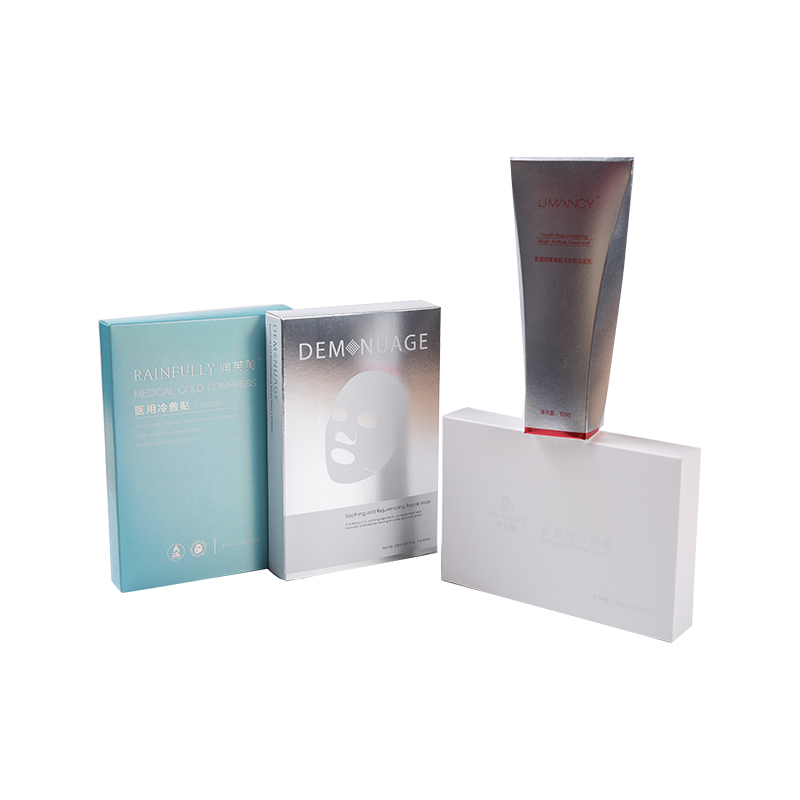 Silver Cardboard Nano UV Printing Mask Paper CartonSilver Cardboard Nano UV Printed Mask Carton is a high-end box that is designed to protect and display mask products. This carton is made of silver cardboard material,...View Product →
Any carton intended for direct food contact has to be built from materials cleared under FDA 21 CFR 176.170 in the United States, or covered by EU Framework Regulation 1935/2004 with paper support documented to BfR Recommendation XXXVI in Europe.
Windows are where compliant board most often gets undermined by an unapproved adhesive. Rigid PET windows run 0.3 mm to 0.5 mm thick and are the default for retail; PVC is cheaper and clearer but is increasingly refused by European buyers. Grease-resistant liners matter for pizza and fried-food cartons, where uncoated 400 gsm board will wick oil within minutes. For liquid-adjacent products such as aromatherapy oils, the board also needs a PET film layer, because a paper-only carton shows staining within a 48-hour accelerated ageing test.
A 350 gsm white card with a transparent window and a printed security code is the common configuration for pharmacy and personal care goods, where visibility and tamper evidence are both specified.
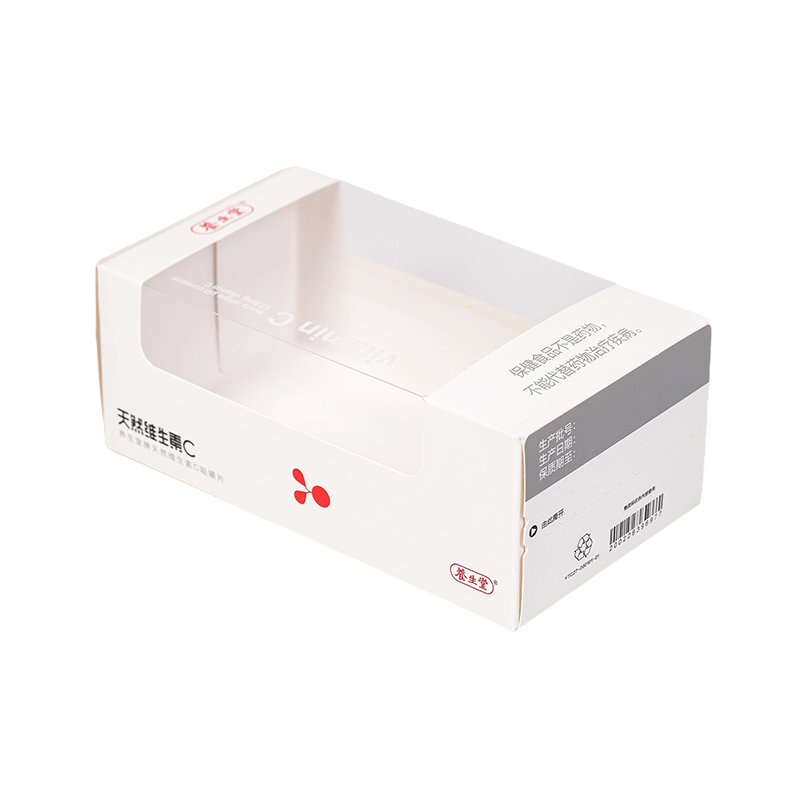 350g White Card Color Printing Transparent Window Packaging Carton With Security CodThe 350g white card color printed transparent window packaging box is made of high-quality white cardboard and combined with advanced anti-counterfeiting code printing...View Product →
Pick the flute profile from the load: E-flute at roughly 1.5 mm carries printed retail-ready cases up to about 10 kg, B-flute at 3 mm covers 10 kg to 20 kg, and BC double wall at 6 mm is the choice above 20 kg.
Edge crush test (ECT) predicts stacking strength, and box compression test (BCT) to ASTM D642 is what actually validates a pallet configuration. The McKee formula estimates BCT from ECT, board caliper and box perimeter, and it is accurate enough for early screening, but no formula replaces a physical compression test on the finished case.
ISTA 3A covers parcel-delivered packages and should be run before the first production order, not after the first damage claim.
Where the same brand mark has to appear on the retail carton and the shipping case, running both through one converter keeps a single colour target across both packs. Suzhou New Century Color Printing Co., Ltd., based in Suzhou National High-Tech District, runs offset, flexo and die-cutting under one roof, which is the practical way to hold that consistency.
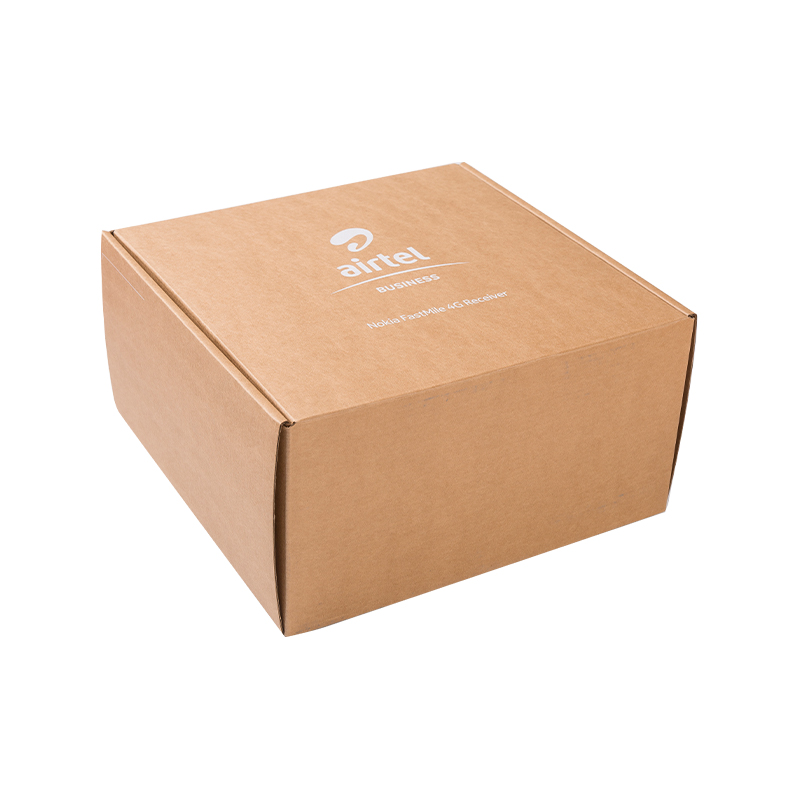 Offset Printing Designs Cartons Packaging Boxes Folding Carton PackagingOffset Printing Designs Cartons Packaging Boxes Folding Carton Packaging is designed to meet the needs of different industries. These packaging boxes use advanced offs...View Product →
Work through the decisions in this order and every later choice is constrained by a fact rather than a preference.
Use packed product weight as the first filter, then confirm with a caliper check and a fold test. The bands below assume a filled carton handled by hand or seated in a shelf-ready display tray.
These bands are starting points, not limits. A 600 g glass bottle needs more protection than a 600 g textile pack, so weight sets the floor and fragility sets the final specification.
No. Stiffness scales with caliper cubed, not with grammage, so a 350 gsm folding boxboard at 0.50 mm caliper outperforms a 400 gsm recycled sheet at 0.45 mm on the same fold line. Compare caliper and grade before comparing weight.
Lamination, hot stamping and spot UV are three separate passes, and together they typically move unit price by 15% to 30% at a 10,000-piece run. Each extra pass also introduces a defect mode, so specify the minimum the shelf requires.
For folding cartons, below roughly 1,000 pieces, because plate and die costs dominate the quote at that volume. Above 3,000 pieces offset becomes cheaper per unit and holds tighter colour consistency against the ISO 12647-2 target.
Yes. PET windows must be separated before repulping, so many European mills classify windowed cartons as non-recyclable in standard fibre streams. If a fibre-only claim is required, replace the window with a die-cut aperture.
Printed Colorful Candy Packaging Carton Box is a high-qualit... View More
Customizable Shapes Corrugated Paper Display Boxes & Car... View More
Our custom designed home appliance packaging cartons provide... View More
Specialty Embossed Paper Aroma Carton is a beautifully craft... View More
No. 88, Zhiying Street, High-tech Zone, Suzhou City, Jiangsu Province, China.
+(86)-512-6575-0991
+(86)-13776090470

Copyright © SuZhou New Century Color Printing Co., Ltd. Custom Printed Colored Corrugated Boxes





 Français
 Español
 عربى