
Article Directory
The PDQ Display Boxes (Products Displayed Quickly) serves as the final, critical touchpoint for a product, driving impulse purchases and reinforcing brand recognition right at the point of sale (POS). For B2B procurement professionals, the challenge is not just structural integrity but maximizing visual impact. This requires resolving a dual printing problem: how to achieve photorealistic image quality (high resolution) alongside precise adherence to established corporate brand colors (Spot Colors) on corrugated material.
Suzhou New Century Color Printing Co., Ltd. specializes in paper color printing and corrugated boxes, operating under the strict guidance of ISO9000 quality management, ISO14000 environmental management, and GMI certification. Our operational philosophy—"keep improving product quality and serve customers with honesty and trustworthiness"—ensures that the strategic printing decision for every PDQ Display Boxes is driven by both technical capability and unwavering quality control.
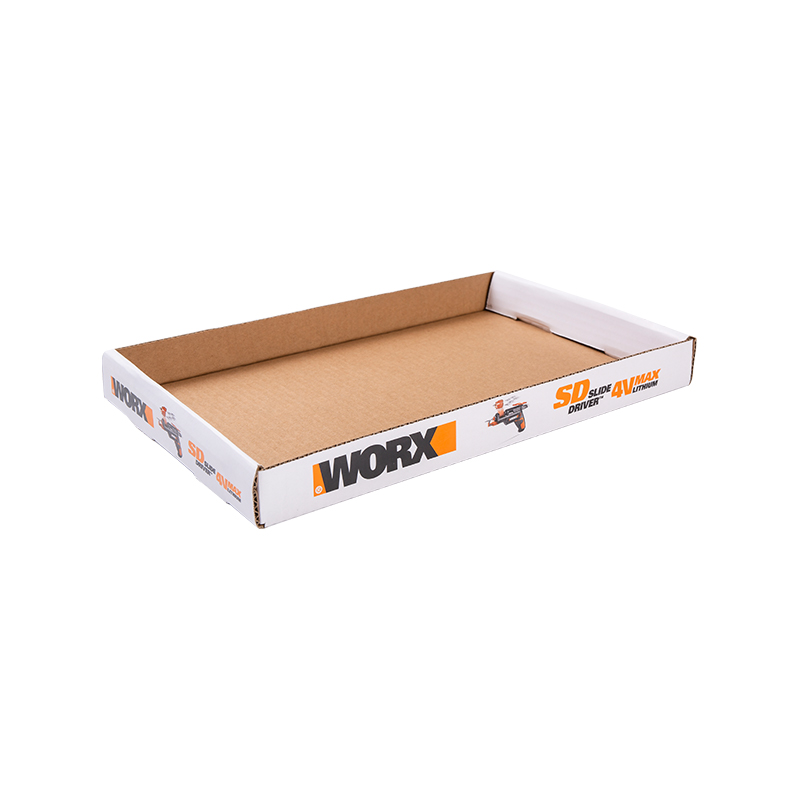
The choice between Offset (Litho-Lamination) and Flexography (Direct Print) is a trade-off between image fidelity, production volume, and cost structure.
Offset printing, combined with litho-lamination (printing onto a fine paper sheet before mounting it to the corrugated board), offers vastly superior resolution (typically 175 lines per inch or higher). This makes it mandatory for complex graphics, gradients, and photographic realism, ensuring High resolution graphics on corrugated PDQ boxes. Flexography is a direct-to-board process, using photopolymer plates. While faster and cheaper, its resolution is limited (typically 85 to 133 LPI) due to the coarse nature of the corrugated liner board, making it better suited for simpler designs and block colors, which is why it is used as one of the Cost-effective printing methods for PDQ counter displays for less graphically intense items.
| Printing Method | Primary Application | Typical Resolution (LPI) | Spot Color Accuracy | Substrate Contact |
|---|---|---|---|---|
| Offset (Litho) | Premium Graphics, Photo Imagery | 175+ | Excellent (Controlled Ink Film) | Indirect (Liner laminated post-print) |
| Flexography | High Volume, Simpler Graphics | 85 - 133 | Good (Color achieved through direct ink laydown) | Direct (Prints directly onto corrugated liner) |
For Achieving brand spot colors on PDQ display boxes (e.g., precise corporate reds or blues), Offset generally provides greater consistency due to its highly controlled ink film thickness and smoother printing surface (the laminated liner). While Flexography can utilize true Pantone inks for Achieving brand spot colors on PDQ display boxes, its direct-to-board nature means the ink absorption and the texture of the corrugated liner can affect the final perceived color, requiring more stringent process control to minimize deviation.
Regardless of the printing method, maintaining color consistency across large batch runs is paramount for B2B brand compliance.
Before production begins, precise pre-production proofing is mandatory. Digital contract proofs simulate the High resolution graphics on corrugated PDQ boxes and must be approved by the customer. However, for true color fidelity, press proofing (a small, accurate sample run) on the actual corrugated substrate is crucial to account for the physical variables of ink absorption and final finish. This minimizes disputes related to color shift.
During mass production, Color consistency management for retail display packaging relies on advanced technology and certified processes. Our commitment involves full-process control, using in-line spectrophotometers to measure color against approved standards throughout the run. This is essential, particularly for ensuring that Achieving brand spot colors on PDQ display boxes remains accurate from the first box to the last. Our GMI certification validates our capability to meet these strict, repeatable color standards required by major retailers.
Procurement must strategically match the product's visual requirements with the appropriate printing investment.
B2B buyers facing large volume orders with simpler graphic requirements should lean toward Flexography as one of the Cost-effective printing methods for PDQ counter displays. Conversely, premium products or items requiring high-impact imagery for market launch must prioritize Offset litho-lamination to guarantee the required High resolution graphics on corrugated PDQ boxes, accepting the higher unit cost due to the superior visual fidelity and color control.
Suzhou New Century Color Printing Co., Ltd. offers the advantage of an integrated enterprise, specializing in paper color printing and corrugated box manufacturing. This integration ensures that the quality policy of "full participation and full process control" covers not only the printing phase but also the lamination, die-cutting, and final assembly of the PDQ Display Boxes, leading to superior structural and visual outcomes.
The selection of the optimal printing method for PDQ Display Boxes is a strategic decision that balances visual impact against production economy. Whether utilizing the high fidelity of Offset or the volume efficiency of Flexography, commitment to robust Color consistency management for retail display packaging through certification and process control is the non-negotiable factor that safeguards brand equity and ensures sales success at the crucial point of sale.
Offset Printing Designs Cartons Packaging Boxes Folding Cart... View More
Customizable Shapes Corrugated Paper Display Boxes & Car... View More
Tear-off Display Carton is a paper box with a special design... View More
PDQ Quick-Pack Environmentally Friendly Packaging Paper Box ... View More
No. 88, Zhiying Street, High-tech Zone, Suzhou City, Jiangsu Province, China.
+(86)-512-6575-0991
+(86)-13776090470

Copyright © SuZhou New Century Color Printing Co., Ltd. Custom Printed Colored Corrugated Boxes





 Français
 Español
 عربى
عربى