
Article Directory
Every retail buyer has seen the failure pattern. A hanging box slips off the peg, sags sideways, or tears at the reinforced hole before the first customer reaches for it. Retail hanging boxes fail in three predictable ways: wrong hole geometry, weak substrate, or a crease line that collapses under the load. The fix is not a stronger hook or a better adhesive. It is a design process that starts with the hook system and ends with a box that survives handling from the warehouse to the pegboard. SuZhou New Century Color Printing Co., Ltd. has produced custom paper packaging since 2000, and we have seen this process fail in nearly every product category before a design was corrected.
The hole is the load-bearing structure. If it does not match the hook, the box will hang at an angle, slide off, or tear, regardless of how strong the board is. The most common standards are the Euro slot and the round pegboard hole. The Euro slot is approximately 8 mm wide by 24 to 30 mm long. A round pegboard hole is usually 6 mm or 8 mm in diameter. The hole must be positioned so that the product's centre of gravity sits below the top edge; otherwise the box pivots forward and falls. Standard Euro slot placement is between 15 and 20 mm below the top edge, with the slot opening facing the hook.
On a double-hole design, the two holes must be spaced so they meet the retailer's two-prong hook exactly. If the spacing does not match, one hole carries the entire load and the box hangs crooked.
| Hole type | Dimensions | Typical hook | Best for |
| Euro slot | 8 mm x 24-30 mm | Wire hook, 2-3 mm stem | Supermarket pegboard displays |
| Round hole | 6 mm or 8 mm | Single-wire hook | Light retail items and carded merchandise |
| Double hole | 2 x 6 mm, 30-60 mm apart | Two-prong hook | Heavier items needing balance |
Key metric: the Euro slot's 8 x 30 mm opening can hold up to 25 N of pull-out force on a 3 mm wire hook when the board is 350 g/m2 or heavier.
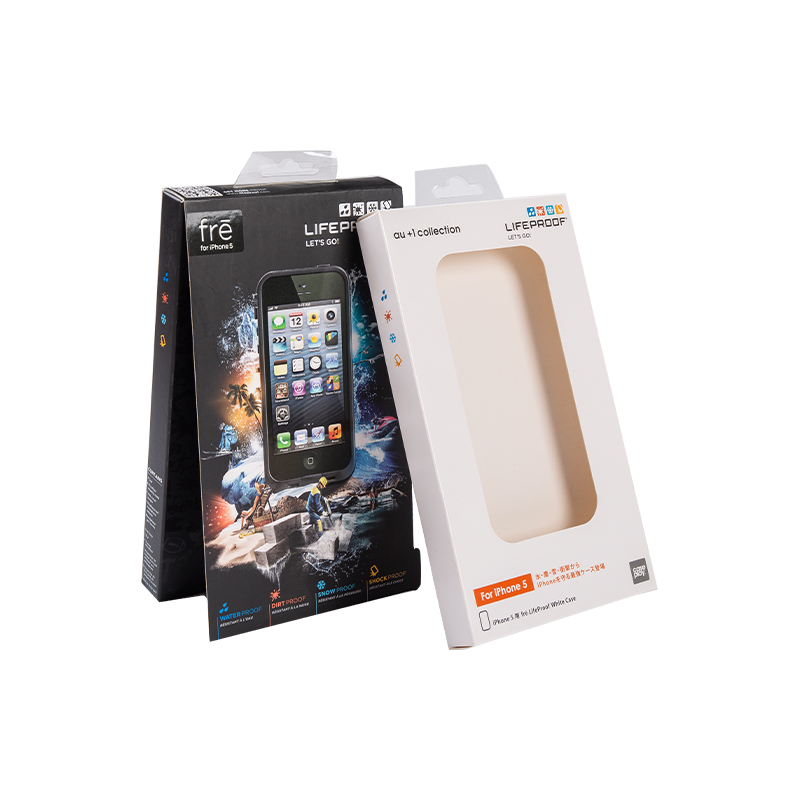 Printed Polypropylene Retail Packaging Box with Hanging HoleThis polypropylene box offers moisture resistance and durability, with a standard hanging hole for retail display. Its load capacity suits various products, making it a practical choice for showcasing goods.View Product →
The substrate determines the load ceiling. Pick the board first, then design the hole and crease around it. A 350 g/m2 white card is the default for most hanging boxes and supports a single-point load of roughly 350 g. A 400 g/m2 board pushes the limit to about 450 g. Polypropylene (PP) adds water and chemical resistance while carrying close to 600 g at the same footprint. Corrugated board handles the heaviest items but takes more shelf depth.
For retail environments, the material choice also affects printing. White card gives the sharpest colour reproduction. PP is more durable for products that face humidity, such as cosmetics and cleaning supplies. E-flute corrugated suits heavier hardware products, but print quality on the uncoated surface is more limited.
| Material | Basis weight | Hole reinforcement | Max single-point load |
| White card | 350 g/m2 | Required | 350 g |
| White card | 400 g/m2 | Required | 450 g |
| Polypropylene | 0.4 mm / 250 g/m2 | Not required | 600 g |
| E-flute corrugated | 125 g/m2 board | Not required | 800 g |
Load ceiling rule: the board's single-point load capacity drops by 20 percent when the box is hung for more than 24 hours, because the paper creeps under constant strain.
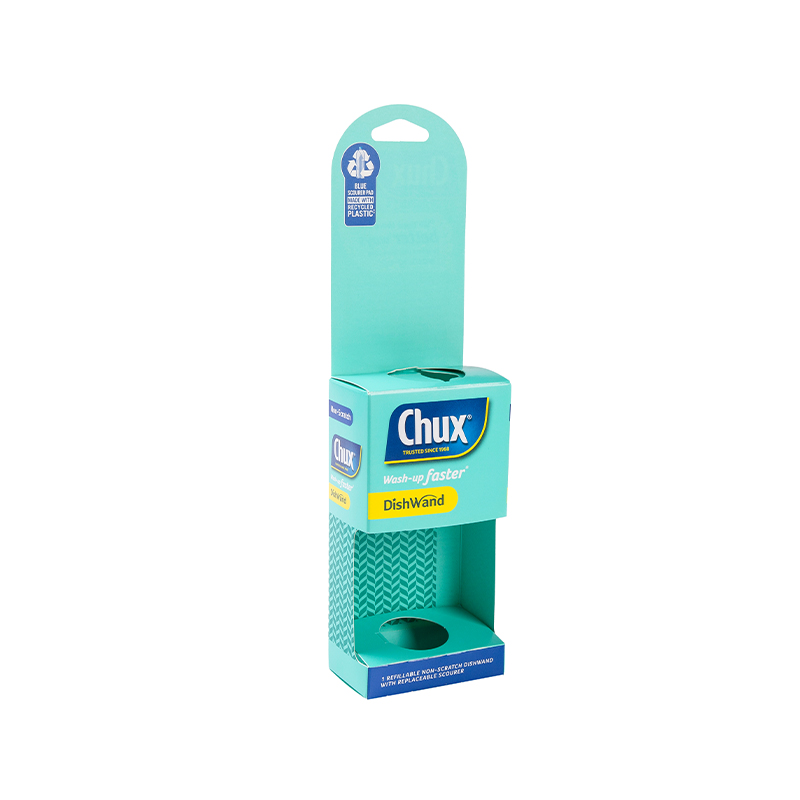 Gift Box Carton with Hanging Hole and Clear PVC WindowFeaturing a clear PVC window and hanging hole, this carton displays products effectively while providing protection. Ideal for retail, it supports moderate loads and enhances product visibility.View Product →
If the hole measures 8.2 mm when the hook is 7.8 mm, it will still fail. The tolerance window is the real specification. Standard die-cutting holds dimensions to the first pass. Tooling wear widens the hole with every stroke, so after 50,000 presses, recheck the hole size with a pin gauge. Edge quality matters just as much. A smooth edge prevents micro-fractures that grow into tears during repetitive use.
On a 350 g/m2 board, an unreinforced hole begins to deform after roughly 10 hook cycles. That is only ten changes on and off a pegboard before the box no longer hangs straight. Review the hanging hole packaging standards that cover dimension checks and material requirements for retail-ready cartons.
Packaging rule of thumb: every 0.1 mm of clearance between the hook and the hole reduces the box's lateral holding force by roughly 15 percent.
A hanging box has about 0.0144 m2 of visible surface at pegboard level. That surface has to make the shopper stop or the box is just a storage container. Use a bold product name, a clear visual path, and high-contrast graphics that are readable from one metre away. Surface treatment protects the print during handling and defines the perceived quality of the product.
Visibility rule: from a merchandising perspective, the first 30 seconds of a shopper's scan decide whether a hanging box gets picked up or passed over.
A transparent window can replace a product photo, but it also changes the structural behaviour of the box. For cosmetics, small electronics, and confectionery, showing the physical product is often stronger than any print. A PET window keeps the product visible without touching the goods. The window removes board area, so the distance between the hole and the window must be at least 1.5 times the hole height to avoid tear propagation.
For a deeper look at combining visibility with stability, read our guide on transparent window and hanging hole design.
Structural note: the compression strength of a windowed panel drops by roughly 15 percent compared to a solid panel of the same caliper, so keep the window below the hole.
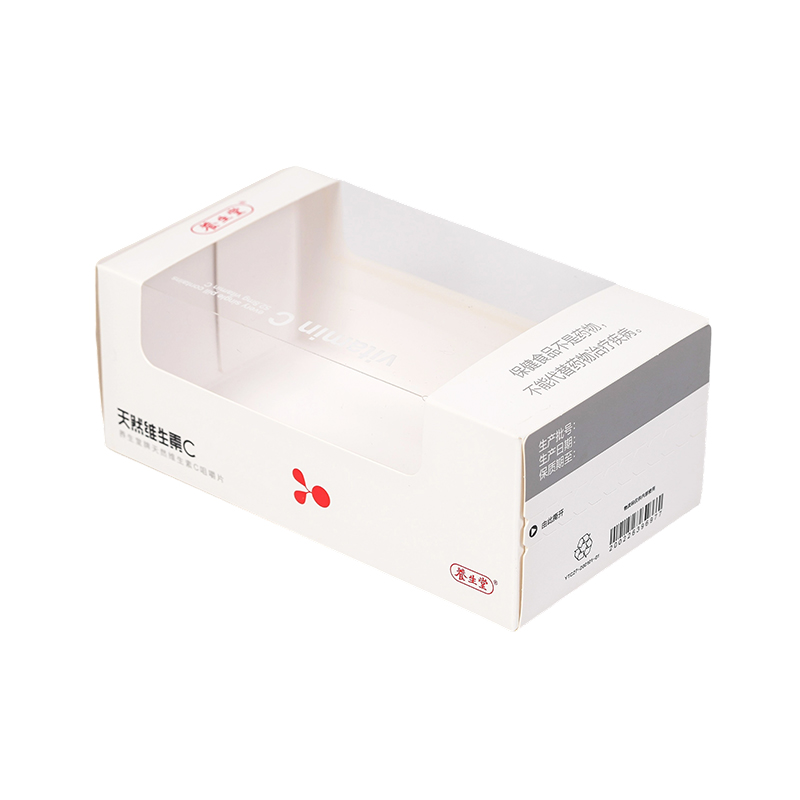 White Card Carton with Transparent Window and Security CodeThis 350g white card box includes a transparent window for product visibility and a security code for anti-counterfeiting. The easy-tear strip ensures tamper-evidence, suitable for sensitive items.View Product →
A hanging box that takes three minutes to assemble will not survive the move to the shelf. Retail staff often assemble hanging boxes on the shop floor. If the assembly process is fiddly, the box gets discarded before it reaches the pegboard. Design for fold-flat delivery, one-piece construction, and a locking tab that removes the need for tape. The box should open and close at least three times without losing strength.
Shelf-ready target: a hanging box should assemble in under 15 seconds without tape or glue, and collapse flat for return transport.
The Euro slot is 8 mm wide by 24 to 30 mm long. For pegboard hooks, a round 6 mm or 8 mm hole is common. The exact spec must match the hook diameter used by the retailer.
A 350 g/m2 white card box with a reinforced hole can hold about 350 g at a single point. A 400 g/m2 box reaches about 450 g, and a PP or corrugated box can exceed 600 g.
Yes, if the visual proof of the product is the main selling point. A PET window adds visibility but weakens the box, so keep the hole at least 1.5 hole-heights away from the window edge.
Use a reinforced hole patch, set the tolerance to +/-0.2 mm, and score the crease lines at 1.5 mm depth. Check the hole size after every production run and test the box with a stack test before shipping.
Printed PP retail product packaging boxes are a high-quality... View More
Gift tag retail packaging box carton with hanging hole and t... View More
Electronic Products Packaging Design Carton Boxes Packaging ... View More
The outer packaging box is designed for blind boxes, prize r... View More
No. 88, Zhiying Street, High-tech Zone, Suzhou City, Jiangsu Province, China.
+(86)-512-6575-0991
+(86)-13776090470

Copyright © SuZhou New Century Color Printing Co., Ltd. Custom Printed Colored Corrugated Boxes





 Français
 Español
 عربى
عربى