
Article Directory
A wall of shelves is a harsh testing ground for packaging. Within hours, a carton with a poorly cut hanging hole can tear, sag, or slip off its hook. Consumers rarely notice the engineering behind a clean, sturdy hanging box—they only notice when it fails. So what makes high quality hanging box packaging? The answer lies in four interacting factors: board material, structural design, print finishing, and production control. Get all four right, and the box hangs straight, survives shipping, and sells the product without a second thought.
A high quality hanging box must do three jobs at once. It must display the product clearly, support its weight on a hook, and survive the journey from factory to shelf. That means the structure must resist bending and tearing, the hang hole must be positioned precisely, and the printing must stay sharp even after handling. A carton that looks beautiful in a mock-up but sags on a store hook is not a packaging solution; it is a liability.
In practical terms, high quality is visible in small details: a smooth die-cut edge with no loose fibres, a crease line that folds exactly where it should, a glue seam that does not open when the box is loaded, and a printed surface that does not scuff when stacked in a shipping carton. These details are not accidents. They are the result of deliberate material selection, careful tooling design, and disciplined quality control throughout production.
The base board is the backbone of any hanging carton. For everyday consumer products such as toothpaste, cosmetics, or small household tools, a 350 gsm white card is a reasonable starting point. Lighter boards may crease or bow when the box is suspended, especially if the product inside is heavier than the package suggests. For heavier items, 400–600 gsm boards or laminated boards provide the extra stiffness needed to keep the front panel flat and the hang hole aligned.
The caliper (thickness) matters almost as much as the grammage. Two boards with the same weight can have different stiffness depending on fibre composition and manufacturing method. A high-quality packaging supplier will measure caliper variation and stiffness rather than relying only on nominal weights. This is particularly important for hanging packaging, because the material above the hang hole acts as a small cantilever beam that must resist long-term creep. A board that is too soft will gradually bend under the product's weight, tilting the box forward and making the whole display look sloppy.
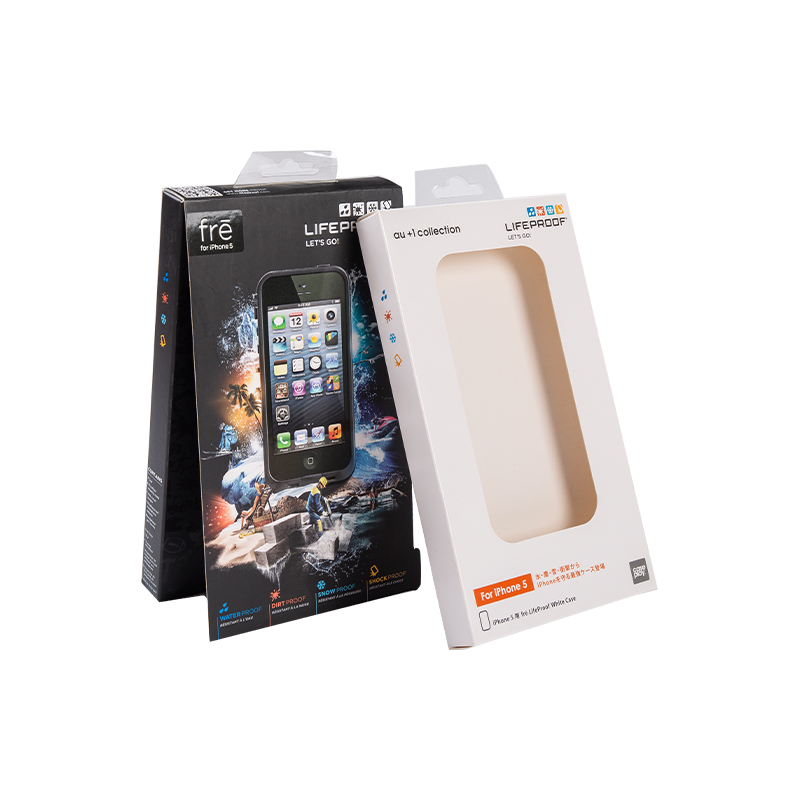
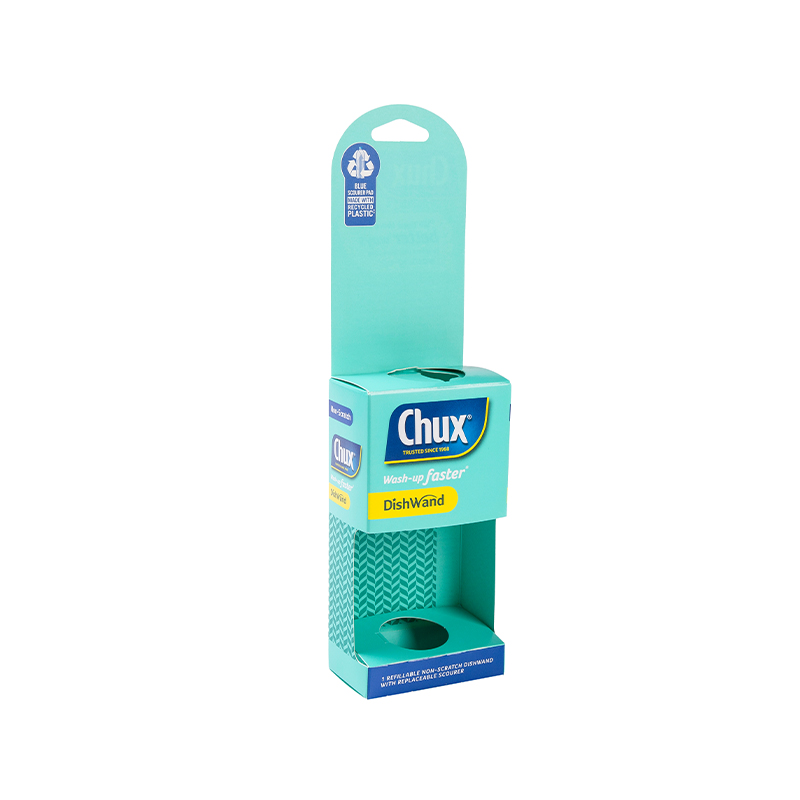
Not every hanging box needs to be paperboard. Polypropylene (PP) boxes resist moisture, grease, and fingerprint marks, making them useful in supermarkets and household cleaning aisles. Many brand owners choose PP packaging boxes with hanging holes for toiletries and cleaning products because the material keeps its shape in humid environments, where paperboard tends to lose stiffness. One specific option is our PP hanging-hole supermarket packaging carton, which combines water resistance with a clean, printable surface for branding. These options show that material choice should be driven by the product's weight, environment, and expected hanging time.
 Wholesale Printed PP Retail Product Packaging Box Hanging Hole Packaging PackagiSuZhou New Century Is China Wholesale Printed PP Retail Product Packaging Box Hanging Hole Packaging Packaging Carton Suppliers, Printed ...View Product →
For heavier retail items, such as hand tools or hobby supplies, a corrugated insert or a microflute laminated sheet can reinforce the hanger area without adding an excessive amount of packaging. Corrugated layers add crush resistance, which matters when boxes are packed tightly into shipping cartons. The key is to align the corrugation direction so that the flutes run vertically, supporting the hang load rather than collapsing under it.
The shape of the hang hole determines how easily the box slides onto a peg and how well it stays put. Common shapes include the fishtail slot, which snaps quickly onto a hook, and the keyhole, which locks the box in place. A round hole is simple but allows sideways movement; a reinforced slot with a wider entry and a narrow locking section offers both speed and stability.
Die-cutting precision is the hidden factor behind every reliable hang hole. The dies must be sharp and well-maintained. A blunt die produces rough edges and loose fibres that tear easily under repeated handling. In retail environments, consumers pick boxes up, replace them, and slide them along hooks, so the edge of the hole is subjected to abrasion. High quality production keeps hang-hole dimensions within about ±0.3 mm and removes all burrs. This tolerance ensures that a box designed for a 6 mm peg fits snugly on every store fixture in the chain.
A hanging box carries all its weight through a narrow strip above the hang hole. That strip needs a continuous load path from the hole to the side panels. Crease lines and glue panels must be positioned so that stress spreads across the whole top edge rather than concentrating on one point. If the crease is too shallow, the box will not fold cleanly; if it is too deep, the board may crack at the surface and weaken the panel.
Glue joints are equally important. A high quality box uses a strong adhesive that bonds the side seam completely, not just in a few spots. For heavier products, additional side tabs or an internal paperboard support can prevent the front panel from peeling away from the back panel. A well-designed supermarket carton with hanging hole uses these principles to support items that would otherwise require a plastic clamshell. The same structural logic applies to wall-mounted packaging for mobile phone cases, small accessories, and stationery.
 Wholesale Gift Tab Retail Packaging Box Packaging Carton With Hanging Hole And CSuZhou New Century Is China Wholesale Gift Tab Retail Packaging Box Packaging Carton With Hanging Hole And Clear PVC Window Suppliers, Gi...View Product →
Print quality on a hanging box is judged at arm's length on a brightly lit shelf. Colour shifts of even two or three ΔE units can make a brand look inconsistent across a product line. High quality printing uses calibrated offset presses, colour-managed workflows, and coated boards that hold ink without mottling. The supplier should be able to match a Pantone reference closely and to maintain that match across different production runs, so that a reorder of the same carton does not introduce a noticeable colour difference.
A protective varnish or lamination also keeps the print from scuffing when boxes rub against each other in transit. Gloss finishes amplify colour saturation, while matte lamination reduces glare and gives a more tactile, premium feel. For hanging packaging, the finish must extend to the edges without peeling. A coating that ends near the hang hole can create a weak point, so the exact area of coverage should be discussed during sampling.
Brands often add UV spots, hot-foil stamping, or soft-touch lamination to raise perceived value. These effects can be applied to hanging boxes, but they must not interfere with the hang area. A transparent PET window is popular for showing the product itself, but the window patch reduces the stiffness of the front panel. That loss must be compensated by a thicker board or an extra crease. Some brands combine hanging holes with transparent PVC window designs to create a strong point-of-sale display, a trend that continues to drive retail packaging decisions.
From a production viewpoint, special finishes only add value if they are registered accurately. A foil-stamped logo that is 0.5 mm off-centre may be acceptable on a shelf in a dim corner, but it will be noticed on a brightly lit end cap. High quality suppliers use optical registration systems and inspect every sheet during printing so that the final carton matches the approved proof.
Consistency separates a reliable packaging partner from an occasional one. When a retail chain orders 50,000 hanging boxes for a national launch, every box must sit at the same angle on the same hook. The table below lists the most critical control points we check during production.
| Control point | Typical tolerance / target | Why it matters |
|---|---|---|
| Hang-hole dimension | ±0.3 mm | Ensures consistent fit on store hooks |
| Board caliper variation | ±0.05 mm within a batch | Prevents bowing and uneven folding |
| Colour difference (ΔE) | ≤ 2.0 from approved proof | Keeps brand colour consistent across cartons |
| Adhesive bond strength | Board tears before glue line fails | Prevents side seams opening under load |
| Crease depth / position | ±0.5 mm from drawing | Ensures clean folds and square corners |
| Surface coatings | Cross-hatch adhesion test passes | Prevents varnish or lamination from peeling |
Beyond these dimensional checks, a mature production line also tests the assembled box under representative conditions. A simple hanging test with the actual product inside for 24 hours will reveal creep, excessive bowing, or adhesive failure. Drop tests on a fully packed carton simulate the bumps of a delivery van, while a humidity chamber test helps confirm that the board and print will not degrade in a damp storage room. These tests may sound expensive, but they are the difference between a packaging problem that surfaces on day one at retail and one that never happens.
Pricing alone does not reveal quality. When evaluating a supplier for hanging box packaging, ask for three things. First, a physical sample that you can hang with the actual product inside, not an empty box. Second, a written tolerance standard for die-cutting and gluing. Third, a colour proof on the exact board grade you intend to use. A supplier that cannot provide these documents may not have the process control required for consistent retail packaging.
It is also worth asking how the supplier handles environmental compliance. Many retailers now require recyclable or responsibly sourced materials, and a good packaging partner can adjust the construction without losing strength. Hanging hole packaging cartons that combine function with recyclability are becoming the new baseline for responsible retail packaging. For example, you can request a board made with post-consumer fibre, or specify a water-based coating instead of a plastic lamination, provided the structural performance is tested again.
Finally, consider the supplier's production experience and location. A packaging manufacturer with an in-house printing press, die-cutting line, and finishing equipment can control quality more tightly than one that outsources each stage. Lead times and shipping distances also affect cost and reliability, especially when a product launch date is fixed. A nearby supplier with a strong quality record will usually be a better long-term partner than a distant one with a slightly lower price, because you can visit the plant, agree on samples, and resolve problems before they become shipment delays.
Printed PP retail product packaging boxes are a high-quality... View More
Printed Colorful Candy Packaging Carton Box is a high-qualit... View More
Offset Printing Designs Cartons Packaging Boxes Folding Cart... View More
Electronic Products Packaging Design Carton Boxes Packaging ... View More
No. 88, Zhiying Street, High-tech Zone, Suzhou City, Jiangsu Province, China.
+(86)-512-6575-0991
+(86)-13776090470

Copyright © SuZhou New Century Color Printing Co., Ltd. Custom Printed Colored Corrugated Boxes





 Français
 Español
 عربى
عربى